Bird Control for HDB Flats & Condos in Singapore
Pigeons, mynas and crows are part of city life, but when they roost on your ledge or balcony they bring droppings, noise, feathers and mites. Effective bird control in Singapore is about humane, legal deterrence — making your space inaccessible and unappealing rather than harming the birds. Here’s how it works for HDB flats and condos.
The birds you’re dealing with
Three species cause most of the trouble around Singapore homes:
- Pigeons (rock doves): roost on ledges and aircon platforms, leaving heavy droppings.
- Javan mynas: noisy, bold, and quick to nest in roof eaves and recesses.
- House crows: raid bins and rubbish chute areas, and can be aggressive near nests.
Each is drawn by the same things — food, water and a safe place to perch or nest. Good bird control starts by removing those.
Why birds are a problem indoors
It’s not just mess. Bird droppings are corrosive and slippery, and they carry pathogens. Just as importantly, nests and droppings harbour bird mites, which can move indoors and bite people once the birds leave. That’s why a heavy bird problem often turns into a secondary pest problem too.
Humane deterrents and exclusion
The most reliable bird control physically blocks access:
| Method | Where it works | Notes |
|---|---|---|
| Bird netting | Balconies, recesses, facades | Best long-term fix; nearly invisible |
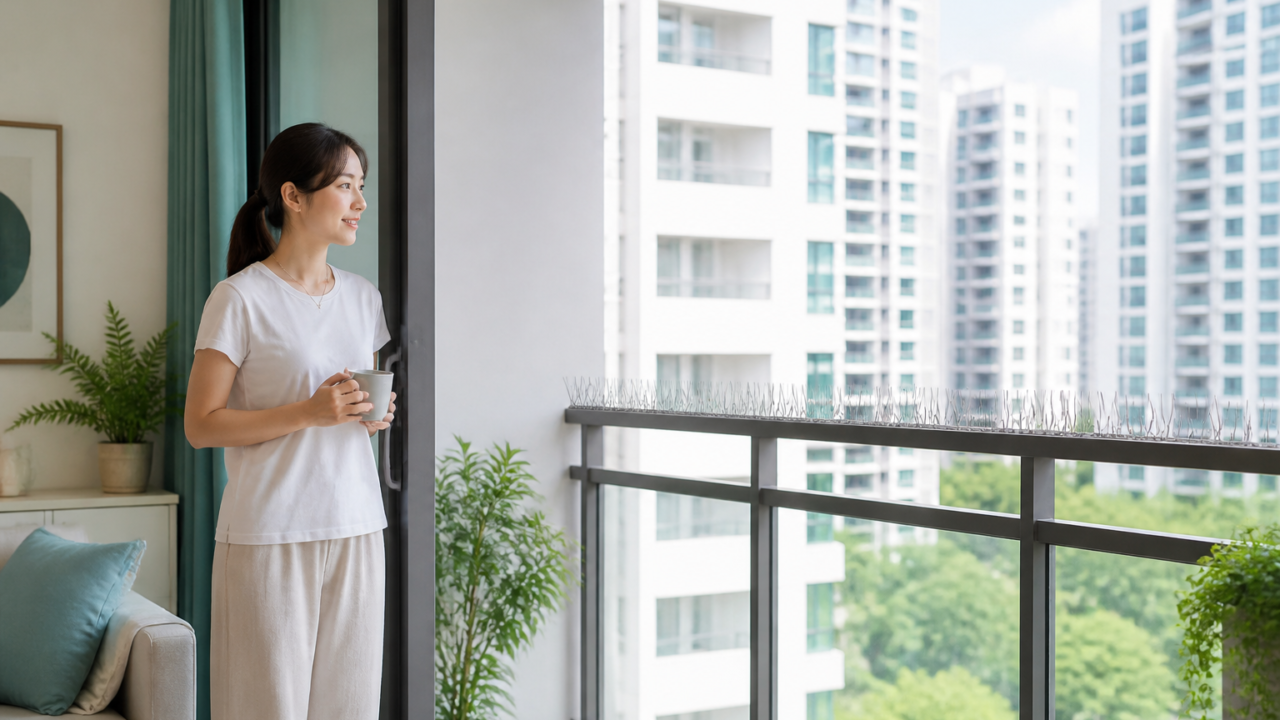
| Anti-roosting spikes | Ledges, parapets, signage | Stops perching, doesn’t harm birds |
| Mesh / screens | Vents, openings, aircon ledges | Keeps birds and insects out |
| Reflective deterrents | Open ledges | Cheaper, needs maintenance |
Before installing anything, clean droppings and remove any partial nests — birds return to familiar scents. For aircon platforms specifically, see our guide on stopping birds nesting on your aircon ledge.
HDB and condo considerations
Where a bird problem sits on your property versus common property changes who handles it.
- Inside your flat or unit (your balcony, your aircon ledge): you can install deterrents, subject to HDB or MCST rules on external fixtures.
- Common corridors, facades, void decks, shared roofs: raise it with your Town Council (HDB) or managing agent / MCST (condo). They handle common-area bird control.
Check before drilling or mounting anything on external walls — many estates have rules on what you can attach to the facade. A no-drill or low-profile solution is often easier to get approved.
What you must not do
Bird control in Singapore has to stay humane and legal:
- Do not poison, trap or injure birds.
- Do not feed pigeons or crows — feeding draws flocks and can attract enforcement attention from the authorities.
- If a neighbour is feeding birds, report it to the Town Council or MCST rather than confronting the birds.
Removing the food source is often the single most effective step, and it’s free.
When to bring in professionals
Call a specialist when:
- Birds have already nested or droppings are heavy.
- Work is needed at height or on a shared facade.
- You need fouled areas cleaned and decontaminated.
- Bird mites have started biting indoors.
Because bird problems frequently come with mites and other pests, professionals may combine bird-proofing with professional pest control to clear what the birds left behind. For a single-species focus, our guide on how to get rid of pigeons goes deeper on deterrents.
How much does bird control cost?
There’s no single price — it depends on the method, the access and the scale. A few spikes on a balcony rail are inexpensive and DIY-friendly. Netting a whole balcony or facade, especially at height, costs more because it needs proper materials and safe installation. Cleaning and decontaminating a heavily fouled area is usually quoted separately.
As a rough guide to budgeting in SGD, expect simple deterrents to be a low-cost weekend job, while professional netting of a balcony or shared facade is a larger one-off investment. Get a few quotes and check whether cleaning and a workmanship guarantee are included.
A simple plan that works
- Remove food and water sources.
- Clean droppings and clear partial nests.
- Exclude with netting, spikes or mesh.
- Coordinate common areas with your Town Council or MCST.
- Treat any bird mites that followed indoors.
Done in that order, bird control stays humane, keeps you compliant, and actually lasts.
Matching the method to the bird
The three common species respond to slightly different tactics, even though exclusion underpins all of them:
- Pigeons are creatures of habit that return to a fixed roost, so spikes on perch lines and netting over recesses work especially well. Our guide on how to get rid of pigeons goes deeper, and bird spikes vs netting helps you choose between the two.
- Javan mynas and house crows are bolder and more mobile, so they often need a combination of exclusion plus removing the food source — open bins, exposed waste and feeding. See getting rid of mynas and crows for species-specific tips.
If you’re genuinely unsure which bird is causing the mess — droppings and feathers look similar — telling doves and pigeons apart is a useful starting point before you spend on proofing.
Frequently asked questions
Can I install bird netting on my HDB or condo facade myself?
Birds are gone but now I’m being bitten — why?
There’s a nest with eggs — can I still proof?
Related guides
- How to get rid of pigeons in Singapore
- How to stop birds nesting on your aircon ledge
- Bird spikes vs netting
- Getting rid of mynas and crows
- How to get rid of bird mites
*Got birds plus the mites they leave behind? Speak to us about pest control.*