How to Stop Birds Nesting on Your Aircon Ledge
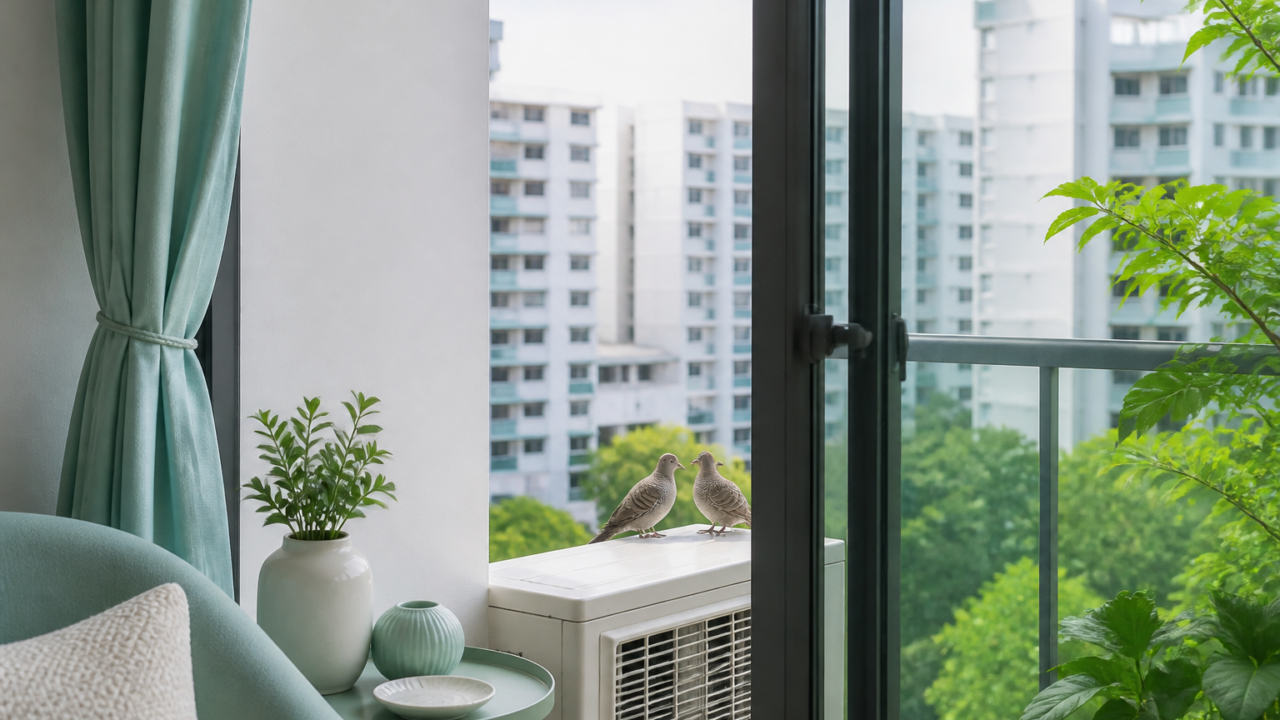
The aircon compressor ledge is prime real estate for pigeons: sheltered, warm and rarely disturbed. If you’ve got birds on your aircon ledge in Singapore, you’re also getting droppings on the unit, blocked airflow and the risk of mites moving indoors. Here’s how to clear them and keep them off for good — humanely and within HDB or condo rules.
Why birds love the aircon ledge
The compressor platform ticks every box a pigeon looks for:
- Shelter from rain and sun under the unit and behind pipes.
- Warmth from the running compressor.
- A flat, stable surface to perch and build a nest.
- Quiet — most ledges are out of reach and undisturbed.
That’s why birds on the aircon ledge keep coming back even after you shoo them away. The fix is to make the space unusable, not just to chase them off.
Clear it out first
Before any deterrent, clean the ledge. Wear gloves and a mask, dampen droppings to avoid breathing dust, and bag everything. Remove any nest material — but if there are eggs or chicks already, leave them until they fledge, then clear and proof immediately.
Cleaning matters because birds return to the scent of old droppings and nests. A clean, deodorised ledge is half the battle.
Deterrents that work on a compressor ledge
| Deterrent | How it helps | Watch-outs |
|---|---|---|
| Anti-roosting spikes | Removes flat perching space | Keep clear of compressor airflow |
| Bird netting / mesh | Blocks access entirely | Don’t restrict ventilation; allow access for servicing |
| Reflective tape / discs | Glare unsettles birds | Needs replacing over time |
| Slope or gel strips | Surface feels unstable | Not for hot surfaces near the unit |
The key constraint on an aircon ledge is airflow and servicing. Whatever you fit must not block the compressor’s exhaust or stop a technician reaching the unit. Bird netting on a removable frame, or spikes around the perimeter rather than over vents, usually works best.
Don’t block the compressor
A compressor needs clear airflow to run efficiently. Smothering it in netting or piling deterrents over the fan will make the aircon work harder and can shorten its life. Fit deterrents to the perch points — the front lip, side rails and any pipe ledges — and leave the unit itself breathing.
If you’re not confident working at the ledge, especially on a high floor, get a professional or your aircon servicer to install proofing safely.
Keep insects out while you’re at it
The same gaps that let birds settle on a ledge let insects in through the aircon opening. Pairing bird-proofing with a proper insect screen for the aircon ledge keeps mosquitoes and crawling pests out of the room too — a useful two-in-one once you’re already working on the ledge.
HDB and condo rules
Before drilling or mounting fixtures on the external wall or ledge, check your estate’s rules. HDB and most MCSTs restrict what you can attach to the facade. Low-profile spikes and no-drill netting frames are easier to get approved, and they avoid damaging the wall.
If the ledge is shared or you can’t access it safely, raise it with your Town Council or managing agent.
Watch for an existing nest before you proof
Before you seal or spike the ledge, make absolutely sure there’s no active nest with eggs or chicks tucked behind the unit or pipes. Proofing over an active nest is both inhumane and can trap birds in a spot where they then die — creating a worse mess and smell. If you find eggs or chicks, hold off on permanent proofing until they’ve fledged, then clear everything and proof straight away so the parents don’t simply rebuild.
This is also a good moment to check the ledge structure itself. Pooled water, rust and debris not only attract birds and mosquitoes but can shorten the life of the compressor mounting. Clearing and slightly sloping water away from the platform helps on more than one front.
When to call in help
Bring in a professional when:
- Droppings are heavy or there’s an established nest.
- The ledge is high or hard to reach safely.
- Bird mites have started appearing indoors.
Bird mites from a nest can bite people once the birds move on, so heavy infestations sometimes need professional pest control alongside proofing. For the bigger picture across your home, see our guide to bird control for HDB and condos.
Clear the ledge, proof the perch points without choking the compressor, and the birds on your aircon ledge will find somewhere else to settle.
Spikes or netting on a compressor ledge?
On most aircon ledges the choice comes down to access. Spikes along the front lip, side rails and pipe ledges remove the perch without enclosing anything, so the compressor still breathes and a technician can still reach the unit — the simplest option for a tight platform. Netting on a removable frame seals the whole gap and is better where birds are squeezing in behind or beneath the unit, but it must be designed to lift away for servicing. Our comparison of bird spikes vs netting weighs up looks, cost and durability if you’re undecided. For a purpose-made option, an insect screen for aircon ledges and vents handles both birds settling and insects sneaking in through the same opening.
If feral pigeons are the main offender, the deterrence playbook in how to get rid of pigeons applies directly to the ledge.
Frequently asked questions
There’s a nest on the ledge already — can I just clear it?
Will deterrents affect my aircon’s performance?
I’ve cleared the birds but I’m getting bitten indoors — why?
Related guides
- Bird control for HDB flats and condos
- How to get rid of pigeons in Singapore
- Bird spikes vs netting
- How to remove a pigeon nest safely
- Pests in your aircon: what to know
*Birds gone but mites left behind? Ask us about pest control.*